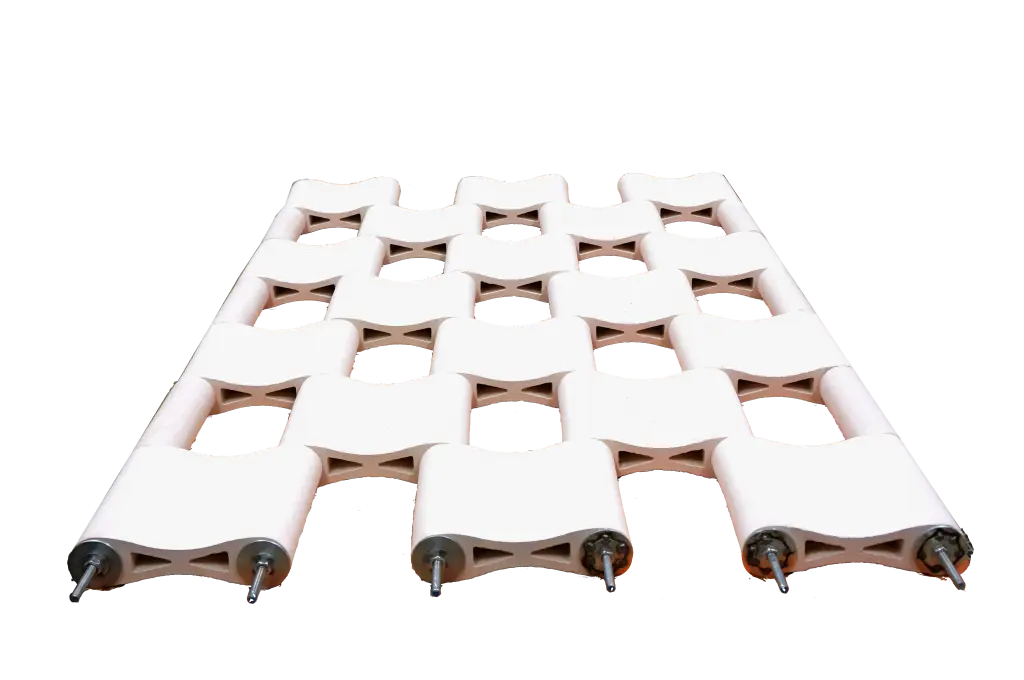
ceramics as a load-bearing element
Ceramics tend to be thought of as tiles, cups, dinnerware — rarely as construction material. That was exactly the question behind Ceramic Re:visions: can ceramics be modularly combined into load-bearing structures? Which geometries make static sense? Where are the limits?
It wasn’t a commission — it was our own project. Founder Philipp Hubmer developed it together with Erich Bscheider as a master’s project at the Institute of Structural Design at TU Graz — while hubmer³ – visualisierungen, the studio, was already running alongside his studies. The work was supervised by, among others, Harvard guest professor Martin Bechthold and professors Stefan Peters, Andreas Trummer and Felix Amtsberg. The goal: a load-bearing building system that spans eight to ten metres using only a handful of ceramic modules.
from clay at the ortweinschule
The modules didn’t stay on the screen. We formed them ourselves from clay in cooperation with the Ortweinschule — in the ceramics workshop, by hand, as real prototypes. Only the fired brick shows whether the geometry holds what the model promises.
from graz and valencia to amsterdam
The project was shown several times: first at the Haus der Architektur in Graz, then at the international ceramics fair Cevisama in Valencia. We presented the system itself at the IASS symposium “Future Visions” in Amsterdam (2015) — the international conference for shell and spatial structures.
why this still matters
A studio that visualises architecture should understand how architecture stands up. That root — material, geometry, statics down to the fired prototype — still shapes how we approach projects today: not only how something looks, but why it holds. The questions have stayed the same.